

PFN, IIJ and JAIST Deploy Direct Liquid-Cooled, High-Density AI Servers in Modular Data Center to Accelerate R&D for Ultra-High-Efficiency AI Computing Infrastructure Technology
TOKYO and NOMI, Japan – March 23, 2026 – Preferred Networks, Inc. (PFN), Internet Initiative Japan Inc. (IIJ) and Japan Advanced Institute of Science and Technology (JAIST) will upgrade their ultra-high-efficiency AI accelerator system, which underwent test operations in IIJ’s Matsue Data Center Park in July 2025, and will start a full-scale operation in April 2026 in the direct liquid cooling modular data center (AImod) constructed within IIJ’s Shiroi Data Center Campus (DCC). This initiative is part of a project jointly proposed and selected in 2023 for the Research and Development Project of the Enhanced Infrastructures for Post-5G Information and Communication Systems/Development of Post-5G Information and Communication Systems (Commission) funded by Japan’s New Energy and Industrial Technology Development Organization (NEDO). On this testbed, the three participants will develop a data center reference model for large-scale AI computing infrastructure with energy efficiency and economic viability.
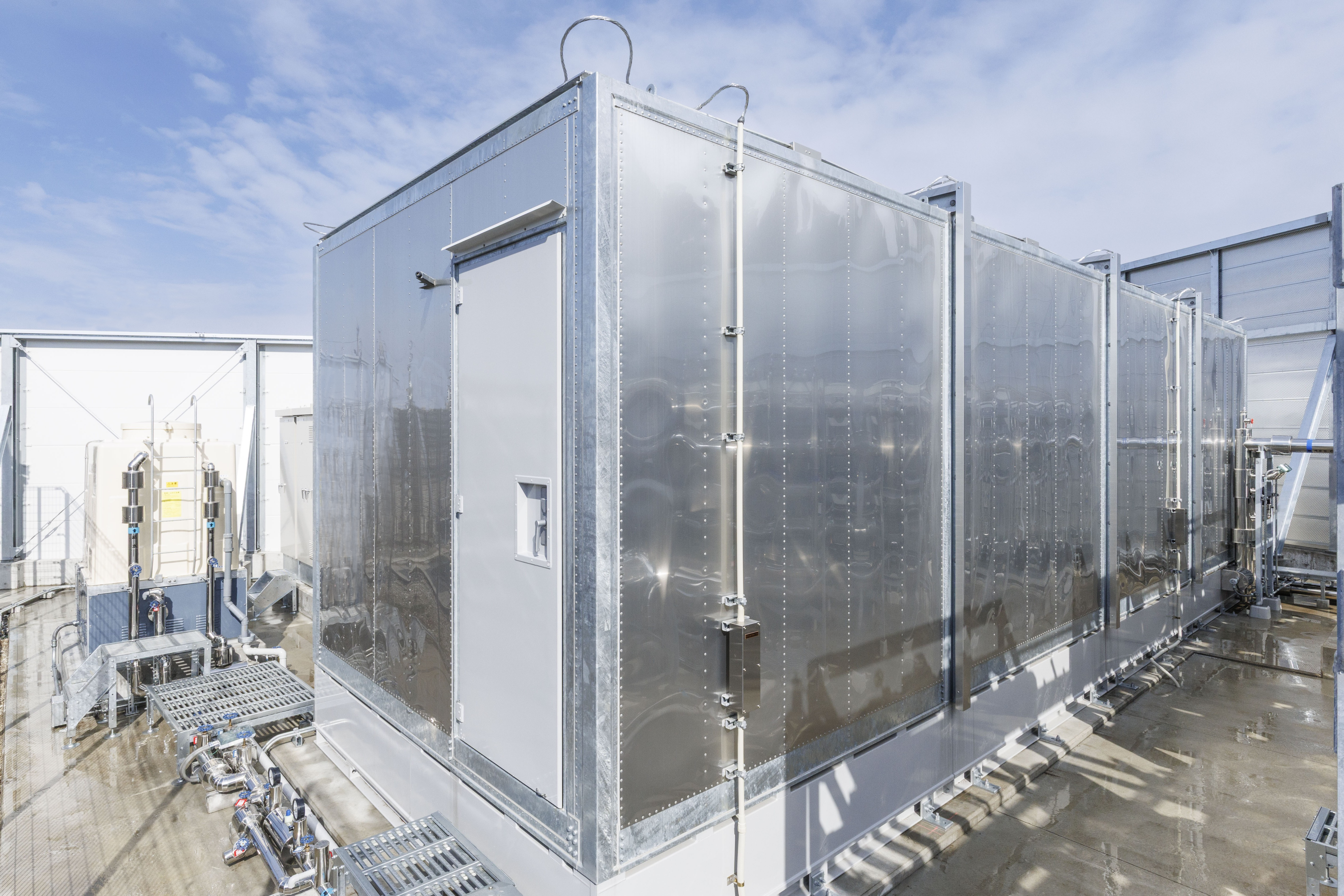
Exterior view of AImod
Background of this testbed evaluation
With the advent of Society 5.0 in sight, domestically developed infrastructure technology is needed to realize advanced AI infrastructure to meet economic security requirements. Simultaneously, the anticipated increase in energy consumption driven by growing AI demand necessitates reducing environmental impact through improved energy efficiency.
The elemental technologies constituting AI computing infrastructure include AI-oriented semiconductors (MN-Core series), networks connecting numerous nodes, and technologies for their high-density installation and cooling. This testbed will integrate these elemental technologies to develop a reference model for an AI computing infrastructure data center designed for practical use, while ensuring coordination and interoperability between these elemental technologies. Specifically, the project aims to evaluate practicality through the operation of AImod, establish and assess energy-saving metrics, and develop an AI computing infrastructure with optimized energy consumption and reduced environmental impact.
Overview of this testbed evaluation
PFN and IIJ will run actual AI workloads to evaluate the efficiency and operational feasibility of the AI computing infrastructure. Additionally, JAIST and PFN will conduct joint research and development on optimizing and enhancing the efficiency of resource allocation in data centers through coordinated operation between water cooling and liquid cooling systems in a software-defined liquid cooling facility. Furthermore, PFN, IIJ and JAIST will jointly conduct tests for liquid cooling technologies and high-density integration of PFN’s next generation of AI processors in the MN-Core series.
The newly developed AImod will be used in actual operations to develop a reference model for water-cooled data centers and establish and assess energy-saving metrics, after which it will be provided as a facility solution with insights to support AI infrastructure construction.
Features of AImod
- High environmental performance via free cooling (*1)
Design pPUE(*2)
- 1.1 units (free cooling mode)
- 1.2 units (annual average)
Design WUE(*3)
0 - Supply with variable chilled water temperature via bleed-in pumps (*4)
Equipped with a function to flexibly adjust the supply water temperature from 17°C to over 45°C for coordinated control with servers, aimed at energy efficiency - Water-cooled/air-cooled hybrid cooling
Based on a 7:3 water-to-air cooling ratio, the servers’ GPUs/CPUs are water-cooled, while other parts are air-cooled - Enhanced power efficiency with three-phase four-wire 400V power supply
Powered via three-phase four-wire 400V, with expected benefits in cost and reduced transformation losses compared to a conventional three-phase three-wire power supply
*1 Free cooling is a method that utilizes natural energy sources, such as outside air, to cool without using compressors or other equipment whenever possible.
*2 PUE (Power Usage Effectiveness) is a metric representing a data center's energy usage efficiency. A value closer to 1 indicates a lower proportion of power consumption by non-IT equipment. pPUE (Partial PUE) is used to represent PUE for each module in a modular data center.
*3 WUE (Water Usage Effectiveness) is a metric representing a data center's water usage efficiency. It quantifies the volume of water (L) used for cooling per unit of electricity (kWh) consumed by IT equipment. A lower value indicates higher water usage efficiency, with zero meaning no water consumed for cooling. While air conditioning systems utilizing the vaporization heat of water, such as cooling towers, consume large amounts of water, the free cooling chillers used in this testing do not evaporate water but circulate it for use, resulting in a WUE of zero.
*4 A bleed-in pump is a pump that mixes warm water returning from servers with the primary-side chilled/hot water for recirculation.
Conceptual diagram
.png)
CDU (Coolant Distribution Unit): A device that circulates, distributes, and controls
the cooling water (coolant) in a direct water-cooling system.
InRow Cooling: An air conditioning method where cooling equipment is
installed between server racks and the “Rows” of racks.
PFN, IIJ and JAIST will proceed with research and development on this testbed, aiming to realize a domestically developed, large-scale commercial AI computing infrastructure powered by ultra-high-efficiency AI accelerators.