

PFN Starts Joint Research with Toyota’s Frontier Research Center to Accelerate Physical AI Using MN-Core L Series Processors
Companies to test ultra-high-bandwidth MN-Core L series for robots requiring high-speed on-premise inference
TOKYO – June 1, 2026 – Preferred Networks, Inc. (PFN) has started joint research with the Frontier Research Center (FRC), Toyota Motor Corporation’s research organization, to accelerate inference processing for physical AI research and development using PFN’s MN-Core™ L Series of AI processors currently under development for inference workloads.
.jpg)
Under the agreement, PFN will provide the software required for the MN-Core L series, while the FRC will conduct research on using the series to accelerate inference processing for robots, with the aim of addressing real-world challenges. After shipments of the MN-Core L series begin in 2027, the companies plan to conduct real-world tests by operating robots in actual environments, and research results are scheduled to be released progressively during 2027.
The FRC conducts research into future technologies that are distinct from Toyota Motor Corporation’s core mobility development. Specifically, using the Human Support Robot (HSR), which Toyota announced in 2012, the center has been conducting remote-operation demonstration tests and advancing large-scale learning using robot motion data collected in diverse environments. It is also pursuing collaborative research on the robotics foundation model that can adapt broadly to a variety of tasks. Running the robotics foundation model in real time requires high-speed generative AI inference in on-premise environments. Looking ahead, efficient inference at the edge will require AI processors to be embedded inside robots.
PFN’s MN-Core L Series is an AI processor series with a new architecture designed to process generative AI inference faster and with lower power consumption than conventional processors. PFN plans to launch its initial models, MN-Core L1100, a low-power model, and MN-Core L1400, a high-performance model, in 2027. Memory bandwidth has become a bottleneck in generative AI inference, the process by which a model receives an input and outputs generated results. The MN-Core L Series is designed to address this issue, offering 50 times higher memory bandwidth than MN-Core 2, PFN’s latest AI processor.
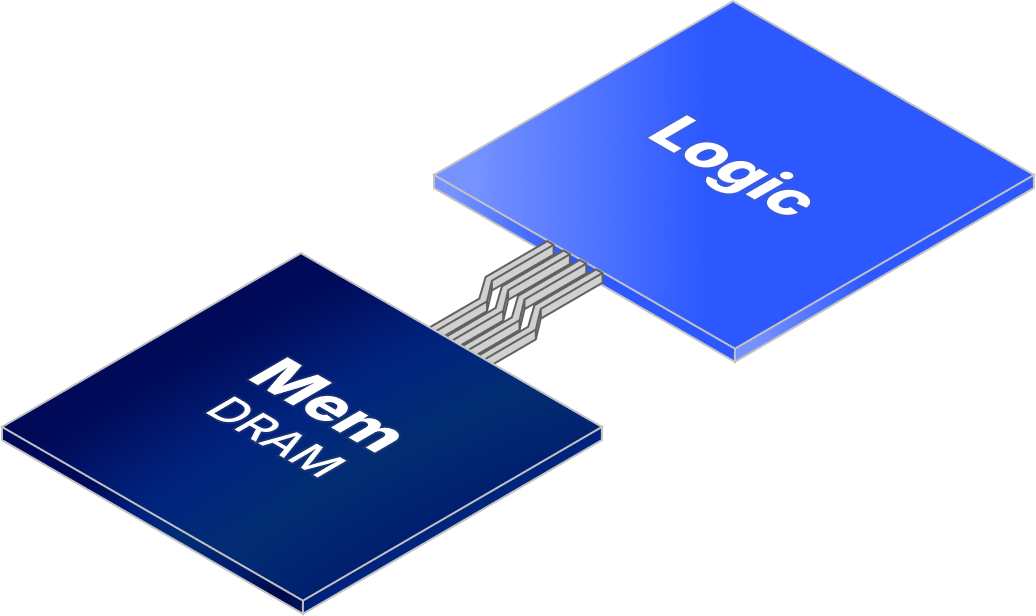
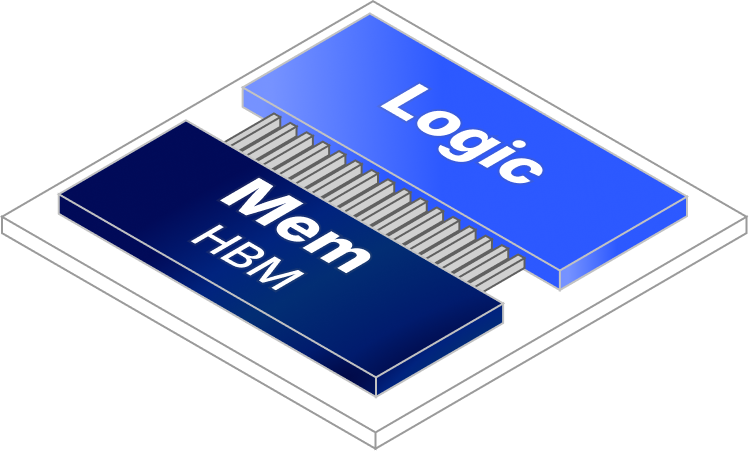
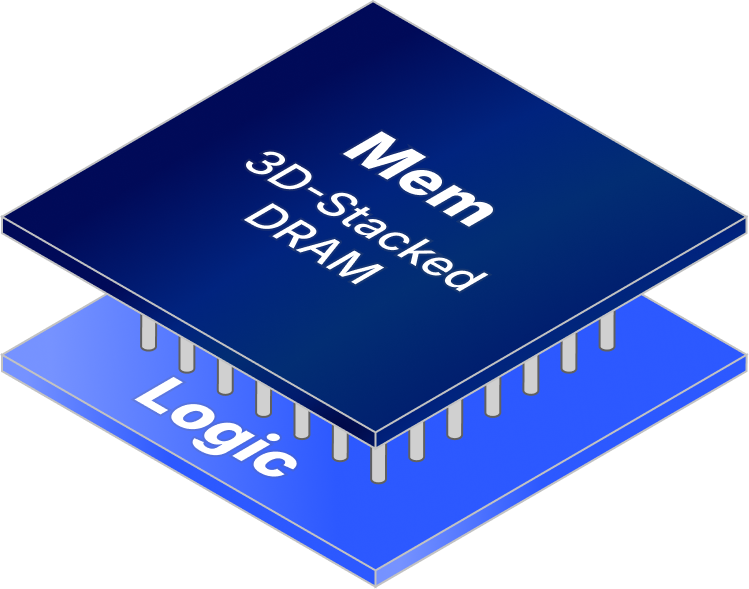
Unlike graphics processing units (GPUs) using graphics double data rate (GDDR) memory or high-bandwidth memory (HBM), which are currently widely used for generative AI inference, the MN-Core L Series vertically stacks relatively low-cost, high-capacity dynamic random-access memory (DRAM) on top of a logic die built with PFN’s proprietary MN-Core architecture. This design enables high-speed inference with memory bandwidth exceeding that of HBM. The MN-Core L Series also offers larger memory capacity than AI processors mainly using static random-access memory (SRAM), which have attracted increasing attention in recent years, eliminating the need for a large-scale system configuration. For example, for widely used large language models (LLMs) with 70 billion parameters, a single MN-Core L1400 card is designed to provide the memory bandwidth and memory capacity required for inference.
Structure of the MN-Core L Series compared with GPUs
GPU+DRAM
GPU+HBM
MN-Core L Series
Hiroshi Bito, Project General Manager at the Frontier Research Center, Toyota Motor Corporation, said:
“Because robots operate in real-world environments, physical AI requires highly responsive, real-time performance. As physical AI systems are expected to become increasingly large-scale and complex, co-designing AI processors and AI algorithms will be critically important. We expect that the MN-Core L series, which is specialized for generative AI inference processing, will further accelerate research and development in physical AI fields including robotics.”
For more information on robots under research by the FRC, please visit Toyota Motor Corporation’s website at: https://global.toyota/en/mobility/frontier-research/
About MN-Core
Jointly developed by PFN and Kobe University, the MN-Core™ series of processors are optimized for matrix operations that are essential for AI computing. To maximize the number of arithmetic units in the hardware, other functions such as network control circuits, cache controllers and instruction schedulers are incorporated into the compiler rather than the hardware. By specializing the hardware in this way, MN-Core achieves high effective performance in AI computing. MN-3, PFN’s supercomputer powered by the first-generation MN-Core, topped the Green500 list of the world’s most energy-efficient supercomputers three times between June 2020 and November 2021. In 2024, PFN launched a server and workstation powered by MN-Core 2, the second generation in the series. In October 2024, PFN also launched Preferred Computing Platform™ (PFCP™), a cloud service that provides access to MN-Core 2 computing power. PFN is currently developing the MN-Core L Series for generative AI inference and plans to launch it in 2027.
*Green500 is a project launched in 2005 based on the view that energy efficiency will be of paramount importance for future supercomputers. A group led by Professor Wu Feng of Virginia Tech has published the ranking twice a year since November 2007. Systems that have entered the TOP500 ranking based on the HPL benchmark are re-ranked by performance per watt.