

PFN Releases Fast, Memory-Efficient Rust Implementation of Optuna as “Rustuna” alongside Optuna v5.0
TOKYO – September 7, 2026 – Preferred Networks, Inc. (PFN) today released Rustuna™, a Rust-based implementation of the open-source hyperparameter optimization framework Optuna™, alongside Optuna v5.0, a major update to the framework PFN has led developing since 2018.
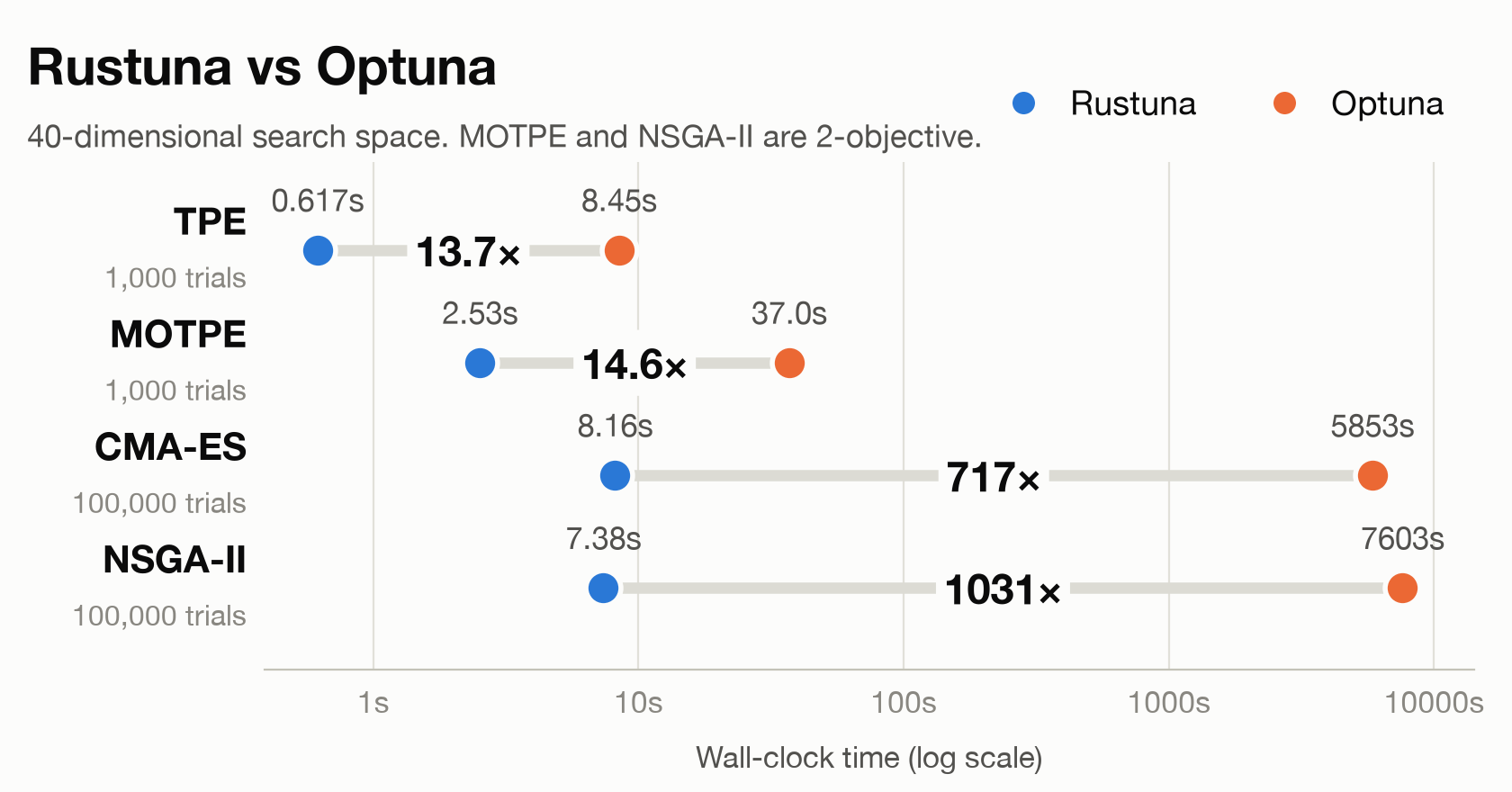
Optuna was originally developed for optimizing machine learning hyperparameters, and its application has recently expanded into various domains including materials science. As its use cases have diversified, scenarios have emerged where standard Optuna designs and implementations face challenges in conducting searches efficiently.
While Optuna is written in Python, the most widely used language in AI, Rustuna implements equivalent functionality in Rust, a programming language known for its performance and memory safety. Compared to Optuna, Rustuna significantly improves execution speed and memory usage, enabling support for broader and larger-scale use cases.
Key features of Rustuna
- High-speed execution
Rustuna can efficiently execute large-scale optimization runs with hundreds of thousands of trials, a scale that was difficult for standard Optuna to handle. In internal PFN benchmarks, Rustuna demonstrated speeds up to 1,000 times faster than Optuna depending on the use case. - Improved memory usage
Rustuna also offers superior memory efficiency. Matlantis Corporation, a PFN group company, uses Optuna in Matlantis CSP, a crystal structure prediction service. In evaluation tests in which Optuna was replaced with Rustuna, memory consumption during searches was reduced by approximately 50% (based on a 100,000-trial benchmark). This significant memory reduction enables a higher degree of parallelism and a much larger number of trials. Full integration is currently under development.
Major new features and improvements in Optuna v5.0
- Performance improvements in default optimization algorithms
The performance of TPE (Tree-structured Parzen Estimator), Optuna's default single-objective algorithm, has been enhanced. Additionally, by switching the default multi-objective algorithm to multi-objective TPE, Optuna v5.0 achieves superior optimization performance compared to previous releases across various optimization tasks. - Support for hyperparameter importance algorithm accepted at KDD 2026
KDD is one of the premier conferences in data science. A research paper proposing an extended method for PED-ANOVA, a hyperparameter importance calculation algorithm, enabling its use in dynamic search spaces was accepted at the KDD 2026 main conference. This method has been implemented in Optuna, allowing users to assess hyperparameter importance across an even wider variety of applications.
For more details, please read the Rustuna release blog post and the Optuna v5.0 release blog post, respectively.
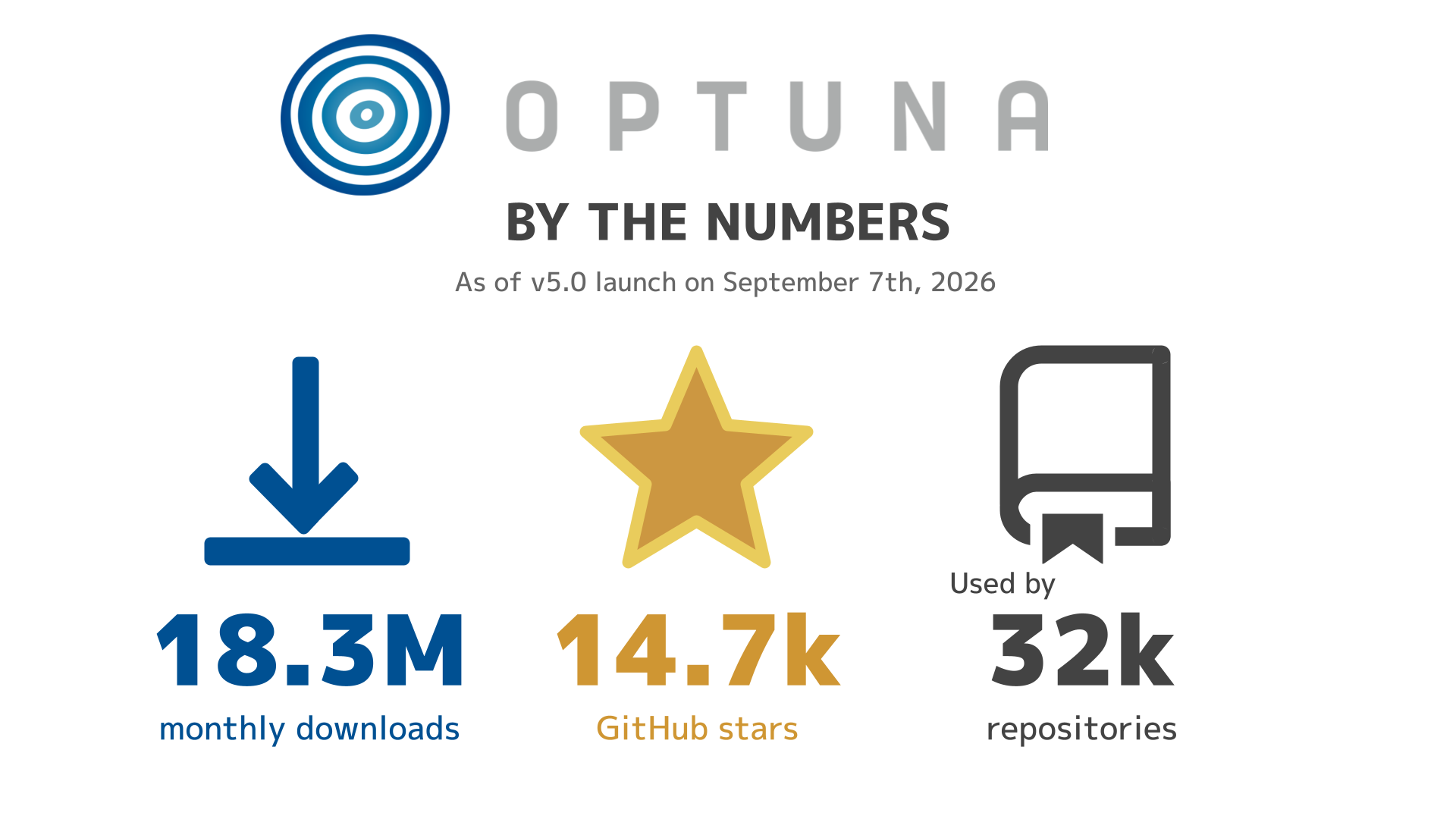
Since the release of v4.0, Optuna's monthly downloads have grown more than 6.1-fold to over 18.3 million, and its GitHub repository stars have increased 1.4-fold to reach 14,700 stars. OptunaHub, a feature-sharing platform launched alongside v4.0, now hosts over 100 features contributed by the community, including state-of-the-art optimization algorithms and performance evaluation benchmarks. In addition, the paper "OptunaHub: A Platform for Black-Box Optimization" (arXiv) has been accepted for publication in the Journal of Machine Learning Research (JMLR), one of the most prestigious journals in machine learning, and will be published soon.
PFN will continue to develop Optuna, while prototyping and implementing advanced functionalities.
About Optuna/Rustuna
Optuna is a hyperparameter optimization framework written in Python. When combined with various machine learning software tools, Optuna can automate the trial-and-error process for hyperparameter search and helps control algorithm behaviors and increase accuracy. Since open-sourced by PFN in December 2018, many external contributors have joined in its development.
- Official Website: https://optuna.org
- Optuna GitHub: https://github.com/optuna/optuna
- Rustuna GitHub: https://github.com/optuna/rustuna
- OptunaHub: https://hub.optuna.org
- Developers Blog (Rustuna): https://medium.com/optuna/announcing-rustuna-cc82a6815bf7
- Developers Blog (Optuna v5.0): https://medium.com/optuna/releasing-optuna-v5-0-an-open-source-black-box-optimization-library-9bff8b4587ba