

ACSL and PFN Reach Demonstration Stage for AI-Based Automatic Flight Route Generation under NEDO’s K Program
- Advancing research and development of AI-enabled autonomous and distributed-control technologies under NEDO's K Program, "Autonomous and Distributed-Control Technology for Small UAVs"
- Reached a stage where demonstrations of automatic flight route generation based on mission requirements and surrounding environments can be conducted using generative AI and related technologies
- Aiming to realize small UAVs capable of autonomously performing missions through multi-drone coordination for applications such as disaster response, emergency assessment, infrastructure inspection, and search operations
TOKYO, September 10, 2026 - ACSL Ltd. (ACSL) and Preferred Networks, Inc. (PFN) have been conducting research and development since October 2025 under the project "Autonomous and Distributed-Control Technology for Small UAVs (R&D Item (2))" within the broader R&D initiative "Autonomous and Distributed-Control Technology for Small UAVs" of NEDO's Economic Security Critical Technology Development Program (K Program). As part of the progress achieved in this project, ACSL and PFN today announced that development has reached a stage where they can conduct demonstrations of automatic flight route generation using AI.
This R&D initiative aims to enable multiple small UAVs (unmanned aerial vehicles) to collaborate and autonomously perform missions in unknown and complex environments. During Phase 2 of the project, which is being carried out from FY2025 through FY2027, ACSL and PFN are developing an initial prototype aircraft while advancing component technologies including AI-based flight plan generation, dynamic replanning in response to environmental changes, object recognition, and obstacle avoidance.
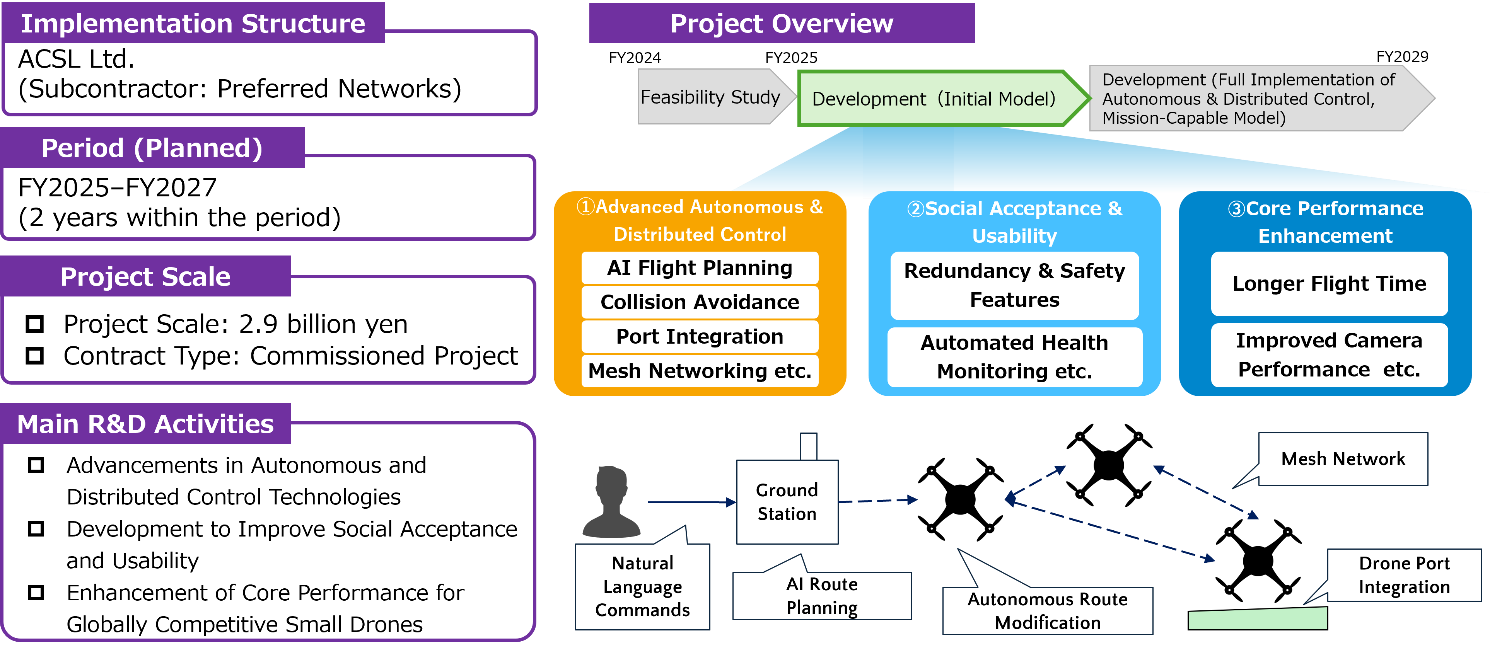
Overview diagram of the K Program “Autonomous and Distributed Control Technology for Small Unmanned Aerial Vehicles”
Automatic Flight Route Generation Demonstration
The automatic flight route generation function demonstrated in this project is intended to generate flight plan proposals using AI based on information such as mission requirements, flight conditions, and surrounding environmental conditions. Conventionally, route planning required advanced operator expertise because flight paths had to be configured individually. This has been one of the challenges associated with operating a large number of drones. By automating part of the route planning process, the technology is expected to support applications that require rapid decision-making and efficient operations, including disaster and emergency response as well as infrastructure inspection.
The demonstration is being conducted as part of technical evaluation during the R&D phase. Going forward, ACSL and PFN will proceed with implementation on small UAVs, validation in environments that simulate real-world operations, and integration with control technologies designed for coordinated multi-UAV operation.
.png)
Automatic Flight Route Generation Function (Screen under development)
About the K Program Project "Autonomous and Distributed-Control Technology for Small UAVs"
The K Program promotes research and development of critical advanced technologies that are essential for Japan to maintain a secure and competitive position in the international community over the medium to long term. Recognizing that advanced technologies can serve a wide range of purposes, the program supports R&D and utilization of outcomes for both civilian and public-sector applications. Based on Japan's economic security needs, the program promotes agile and flexible advancement from research and development through technology demonstration while implementing appropriate measures to prevent technology leakage according to the characteristics and maturity level of each technology.
Under this project, ACSL and PFN are developing an initial prototype of a small UAV capable of autonomous and distributed control. The aircraft is intended to support all six mission categories envisioned for both normal operations and emergency situations, including large-scale disasters: situational assessment, inspection, security, search, surveying, and communications.
Outlook
Through this project, ACSL and PFN will continue advancing AI-enabled autonomous control technologies, thereby further accelerating the advancement of drone technologies and the expansion of industrial applications. They will also continue development of safe and reliable small UAVs and contribute to the broader deployment of domestically developed drones and the resolution of social challenges in Japan and abroad.
*NEDO announcement (in Japanese only)
About ACSL https://www.acsl.co.jp/en/
ACSL is a manufacturer that develops and mass-produces industrial drones made in Japan under the mission, “Liberate humanity through technology.” Built on proprietary autonomous control technology, ACSL's highly reliable products contribute to the maintenance of social infrastructure and the enhancement of safety and security across a wide range of fields, including aerial photography, inspection, logistics, and disaster response.
About Preferred Networks https://www.preferred.jp/en
Guided by its mission to “Make the real world computable and create the future together,” Preferred Networks, Inc. (PFN) develops advanced software and hardware technologies through a vertically integrated approach spanning the entire AI value chain—from AI chips and computing infrastructure to generative AI foundation models and solutions across a wide range of industries. Founded in 2014 in Tokyo, PFN currently develops and delivers the MN-Core™ series of AI processors, the PFCP™ cloud platform for AI computing, and the Japan-developed generative AI foundation model PLaMo™.
The product names and other proper names mentioned in this release are trademarks or registered trademarks of their respective companies.